

Top 8 Online Notary Services for Businesses Handling High-Volume Documents
When document volume grows, notarization stops being a simple step in the process.
At the beginning, it’s easy to overlook. A few documents here and there don’t create pressure. Even if something takes longer than expected, it doesn’t really affect anything else.
But once notarization becomes part of a daily workflow, the situation changes. Documents move through multiple teams. Deadlines become tighter. The same process repeats dozens or hundreds of times. And that’s where things start to show.
Not in a dramatic way. More like friction that keeps appearing in small places. A session takes longer to start. A document needs to be corrected. Someone gets stuck and has to redo a step. None of it feels critical on its own. But together, it slows everything down.
That’s usually when businesses start paying closer attention to how notarization actually works inside their process.
Volume Changes the Way You Look at the Process
At scale, the goal is not just to get documents notarized. It’s to keep the process steady.
That means fewer interruptions, fewer manual fixes, and fewer situations where someone has to stop and figure out what went wrong.
What starts to matter more:
- How quickly a session begins without waiting
- How often documents go through without corrections
- How predictable the flow is from one document to the next
- How easily the process fits into existing systems
If those parts are not stable, volume turns into pressure very quickly.
The Work Doesn’t Stop After the First Document
A single successful session doesn’t tell you much. What matters is how the system behaves over time.
When the same steps are repeated across hundreds of documents, small inefficiencies don’t stay small. They accumulate.
People start adjusting their behavior to compensate. They double-check things that should be automatic. They leave extra time for steps that used to be quick.
That’s usually a sign that the system is doing more work than it should.
1. OneNotary
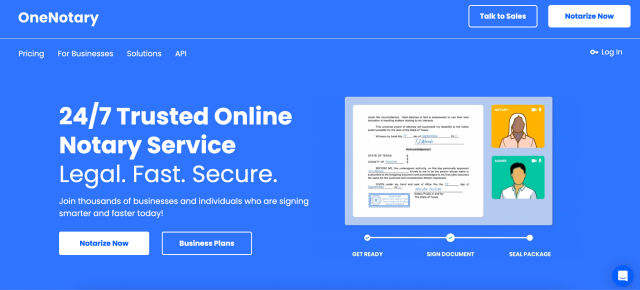
OneNotary is structured in a way that supports repeated use without adding extra effort to each session.
The process is guided from the beginning. Instead of leaving users to figure things out, the platform moves them through each step with clear direction. That reduces hesitation and helps keep sessions consistent.
In industries like real estate, financial services, and legal work, where document accuracy is critical, that consistency becomes noticeable very quickly.
What tends to matter in practice:
- Connection to a live notary happens quickly without long waiting times
- Documents are checked automatically before the session, which helps avoid last-minute issues
- Sessions follow a clear sequence that doesn’t change from one document to the next
- Integration options make it easier to include notarization in existing workflows
The process feels controlled and repeatable, which is what high-volume environments usually need.
2. Notarize (Proof.com)
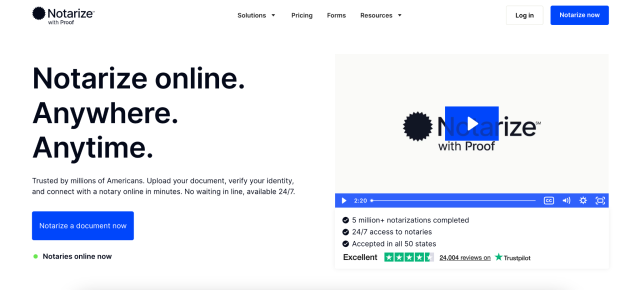
Notarize is often used in environments where notarization is part of ongoing operations rather than occasional use.
The platform is structured in a way that supports continuous activity without requiring adjustments between sessions.
What stands out in day-to-day use:
- Sessions follow a consistent flow that doesn’t require extra explanation
- Document handling remains stable even as volume increases
- Integration with other tools helps keep the process connected to the rest of the workflow
- Support for real estate transactions and similar use cases is well established
The experience stays predictable, which makes it easier to manage across teams.
3. NotaryCam
NotaryCam is often used when the documents themselves require more coordination.
Some transactions involve multiple parties, additional verification, or more structured handling. In those cases, the platform supports a more deliberate process.
What that looks like in practice:
- Sessions are structured to handle more detailed document requirements
- Support is available for transactions that involve multiple participants
- Workflows account for situations where timing and coordination matter
- Industries like legal and real estate use it for more involved cases
The process takes into account the complexity of the documents rather than simplifying it too much.
4. BlueNotary

BlueNotary is often used by teams that want to have more control over how notarization is handled internally.
Instead of relying entirely on an external process, it allows businesses to shape parts of the workflow themselves.
What that enables:
- Managing notarization as part of internal operations
- Adjusting workflows based on how the team actually works
- Maintaining visibility over sessions and document handling
- Onboarding without long setup phases
This approach works well when notarization is closely tied to internal processes.
5. NotaryLive
NotaryLive keeps the process straightforward.
There are fewer layers involved, which reduces the amount of time spent navigating between steps.
What becomes noticeable over time:
- Sessions start quickly without extra setup
- The interface doesn’t require explanation or training
- Users move through the process without unnecessary decisions
- The same flow repeats without variation
That simplicity helps when the same task needs to be completed many times in a row.
6. US Virtual Notary

US Virtual Notary focuses on keeping the process stable and predictable. It follows a clear structure that doesn’t change depending on the document type or situation.
What that means for teams:
- Sessions behave the same way across different use cases
- Users don’t need to adjust their approach between documents
- The process can be repeated without additional guidance
- It fits into standard notarization workflows without modification
That consistency reduces the need for oversight.
7. DocuSign Notary
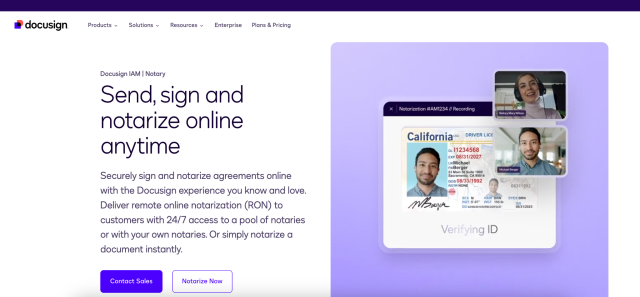
DocuSign Notary fits into environments where document signing is already part of a larger system.
Instead of introducing a separate process, notarization becomes an extension of what teams are already using.
What that changes:
- Documents move through signing and notarization in one flow
- Users don’t need to switch between tools
- The interface remains familiar
- Large teams can manage everything within one environment
That continuity helps reduce friction across steps.
8. SIGNiX

SIGNiX focuses on document integrity and compliance over time.
This becomes relevant in cases where notarization is part of a longer lifecycle, not just a single transaction.
What that looks like:
- Documents are handled with long-term validation in mind
- Identity verification follows structured processes
- Compliance requirements are built into the workflow
- Records remain consistent and traceable
The platform supports environments where documentation needs to remain reliable beyond the initial session.
Where Problems Usually Start to Show
Issues don’t appear all at once. They show up in repetition.
A step that takes slightly longer. A document that needs to be corrected. A user who hesitates because something isn’t clear.
At low volume, those things are easy to ignore. At high volume, they start shaping the entire process.
Why Stability Becomes More Important Over Time
A process that behaves the same way every time is easier to manage than one that constantly changes.
Teams can plan around stability.
They know how long things take. They know what to expect. They don’t need to adjust every time something shifts.
That predictability becomes more valuable than small improvements in speed.
Where AI Helps Without Getting in the Way
In high-volume environments, AI is most useful when it reduces manual effort. It helps before the session starts and after it ends.
In practice, that includes:
- Checking documents for common issues before notarization
- Reducing the number of corrections during sessions
- Identifying patterns in where delays occur
- Improving document handling as more data becomes available
These changes are not always visible, but they affect how smoothly the process runs.
What Makes a System Hold Up Under Load
The systems that handle volume well don’t rely on constant attention. They don’t need users to correct them. They don’t require extra steps to stay on track. They follow a structure that works the same way every time. That’s what allows teams to move faster without having to think about the process itself.
When Notarization Stops Slowing Things Down
At some point, notarization either becomes part of the flow or it interrupts it. If the process is stable, it fades into the background.
Documents move forward. Sessions complete. Teams continue with their work. If it’s not, it becomes something that needs to be managed. And in high-volume environments, that difference becomes clear very quickly.